Native Garden Tour 2025

Native Garden Tour Team

After many highly successful Native Garden Tours we are committed to offering this popular event annually, but we need your help! We are looking for enthusiastic individuals to help us;

  • identify new yards and contact potential hosts(4-5 per year), showcasing a variety of gardening styles
  • coordinate day-of volunteers
  • promote event through social media and other outlets
  • take photos of host sites before and during the event
  • welcome guests to host sites
  • and many more opportunities

If you are interested in learning more please contact: Candice Dalrymple
Habitat HP was thrilled to host our 3rd Annual Native Garden Tour on Saturday, July 12, 2025. Guests meandered through 5 yards with stunning examples of native plants and trees enhancing property while offering food, shelter and way stations for pollinators like birds, butterflies, moths and more.

Homeowners shared how they got started and what were the best or hardest parts of “going native.” Whether coming for inspiration or just to smell the flowers, all went home energized and amazed by these fabulous yards. 

To respect our hosts’ privacy addresses are no longer available.

Anita and Bob’s Garden

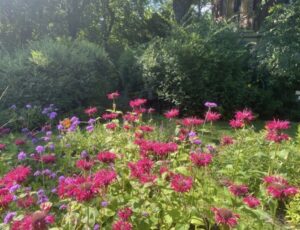
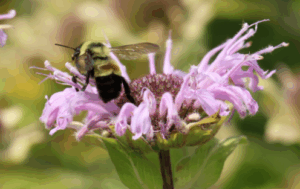
Bright pink Bee Balm is a native that attracts many pollinators. (Monarda)
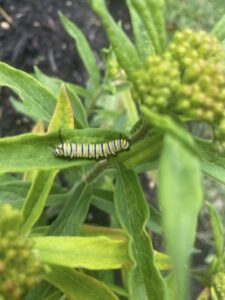
A monarch caterpillar on a Butterfly Milkweed leaf
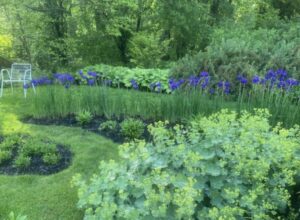
Early blooming irises pop among the many shades of green.

Anita and Bob’s Native Plant Garden

Distinguishing feature of our garden
Our garden combines cultivars and native plants, each in mini-gardens carved from our grassy front yard. It faces the street and we get to share it with everyone who passes by.

How did we become involved in native plant gardening and what motivated us to concentrate on native plants?

I sensed that the world was never going to be the same after the pandemic. A grassy lawn all of a sudden seemed like a silly cultural affectation and a terrible waste of space. I wanted to create a welcoming habitat for bees and birds.

Native plants are sturdy and reliable, a good investment.  They are magnets for all of the  “native wildlife” I wanted to support.  I wanted to create a healthy little ecosystem.  And I am continuously rewarded — a big toad came to visit this year!

Have you encountered any unexpected challenges or surprises?

My garden teaches and surprises me every day.   Examples: What I thought was dead, was just a late bloomer.  Some plants like to be near each other – they thrive in a shared location. Good life lessons. I am challenged by our beautiful river birches, which we planted at the same time as our garden. As they continue to grow, they are starting to block the sunlight.

Have you grown especially attached to specific plants? (Why?)

I am fickle.  I fall in love with each one when it’s at its blooming peak, and then I move on to my next love affair.

Tips for getting started with native plant gardening
Get ideas from The Botanic Garden and other gardens. There’s valuable info on the internet. Look for knowledgeable people at nurseries.

Molly’s Garden

Wild Geraniums — emerge early in the spring and flower in May.
July and August blooming Cardinal Flower
Molly, doing her daily inspections

Molly’s Garden

Distinguishing feature of our garden
We thought our garden location might be a big challenge. It sits partly in shady woods, on a little hill that drains rainwater away from the plants, with a lot of shade and only irregular sunlight. How would we be able to find plants that would thrive in such a location?We found lots of options – and learned that once established, native plants are able to do just fine with local rainfall providing need water and they’re fine with on again-off again sun exposure. No irrigation systems needed after they are established.

How did we become involved in native plant gardening and what motivated us to concentrate on native plants?

We started reading about the plight of pollinators all over the US — for example, monarch butterfly populations have declined by 80% since the 1990s — largely due to loss of habitats and over-reliance on water-hogging grass. Such losses got us wondering if we could build a local environment that could help reverse such terrible losses. When the Habitat Highland Park collaboration with the National Wildlife Federation got started in our town in 2023, we knew we had found a knowledgeable community that could teach us about how our garden could make a difference. Here’s an example of our Cardinal Flowers, a pollinator-friendly July and August bloomer.

Have you encountered any unexpected challenges or surprises? Have you grown especially attached to specific plants? (Why?)

We love the delicacy of Early Meadow Rue and were surprised by its hearty ability to thrive even in low sun light and high foot traffic. It emerges in April and May and resists both Chicagoland’s very cool spring temperatures (low 40s and 50s) well into late May and the hot, humid, and increasingly dry conditions of mid- to late summer. Who would have thought these beauties could thrive in such variable conditions? They’re very cheerful and they wave at us with every breeze. We were also surprised that native plants can complement cultivars. Cultivars don’t have to be banned from your garden if you want to experiment with natives. They play well together.

Name of our garden

Molly’s Garden — it’s hearty enough to tolerate lots of shade, rabbits and other wildlife, and our labradoodle’s daily garden inspections without tempting her to eat what she discovers.

Tips for getting started with native plant gardening
Native plants come in a huge variety of sizes and shapes! Don’t assume you are limited to sunny locations or very tall plants if you want to try native plant gardening. Tall natives such as Joe-Pye or Prairie Dock are pollinator magnets and can be beautiful in the right locations. But if you have limited space, prefer low growing varieties, or just want to start small and experiment, there are many information sources that explain the wide variety of native plants, their flowering periods, and the conditions in which they will thrive. Here’s a handy guide for Illinois native plants to get started. And don’t forget to check in regularly with Go Green Highland Park for lots of articles and event information in the Habitat Corner section of the website.

Maria’s Garden

A bee enjoying some fall asters in my “weed garden,” a patch of dirt that I let grow as it will (removing non-native plants). It currently has a ton of goldenrod, asters, and evening primrose, as well as some ferns. Sometimes I move plants that volunteer in this patch to other parts of our garden.
When we took out a dying crabapple, we kept the stump and turned it into a planter. It is a favorite spot for squirrels to have a snack.
A bee on butterfly weed. This is a milkweed that also likes it a bit drier than our yard, so it goes in planters.
Jack in the pulpit

Maria’s Garden

Distinguishing feature of our garden

Our yard is about a quarter mile from the North Branch of the Chicago River. It was formerly a floodplain forest, then farmland, then 1950’s suburbia. I am working to nudge it closer to its former glory. Being a suburban lot, it is an edge habitat, which opens up a lot of options for plants as habitat edges have a lot of diversity in their growing conditions. Shade and moisture—especially dealing with water runoff—are two of our biggest constraints when choosing plants.
Last summer’s big project was completely overhauling the back yard to deal with water runoff problems. A previous owner had changed the contour of the back yard so water pooled around the garage and ran at the house. We installed a French drain around the garage that empties into a rain garden we built and planted. We also recontoured the back yard to direct water around (rather than at) structures. We put in retaining walls and planted deep-rooted native sedges to prevent erosion. Having taken the entire back lawn to dirt, we replaced the lawn with a low-mow eco-grass. We also used native shrubs to start breaking the back yard
into different zones, including a “secret garden.” We ended up having over 7 TONS of dirt hauled away!

How did we become involved in native plant gardening?

When we first put our offer in on our current house, one of my favorite things about the property was that the yard was dotted with mature trees. The yard felt like it wanted to be a magical woodland. While we were waiting to hear back, I started researching the history of our area and learned that it was a floodplain hardwood forest before it was turned to farms and then suburbia. As I have been ripping out invasive plants and replacing them with our native floodplain woodland and woodland edge plants, I am rewarded with little bits of this magic.

What motivated us to use native plants?

The first thing that motivates me to use native plants is that they are lovely, the second is that (once established) they are quite low maintenance. One of my goals for our yard is to put the work in now to create a thriving, self-sustaining ecosystem so that in future decades, when we will likely have less energy to do things like. But the thing that keeps me going is seeing our yard come alive. When we plant natives, we create habitat for pollinators, birds, small mammals, and even amphibians!

Have you encountered any unexpected challenges or surprises? Even when I research plants and make sure they will (at least on paper) work with the conditions we have, it can still be hit-or-miss. Sometimes, something that looks like a great fit fails to thrive, and sometimes something that seems like I am pressing my luck thrives beyond all expectations.

Another thing that can be an adjustment is that many of our native perennials can spend years working on their root structures underground before they do much that we can see. I planted wild geraniums and assumed they died when they didn’t come up the next spring. I was delighted when their leaves came up the second year, and even more so when they put out lovely sprays of pink flowers in their third year!

Also, when a native plant likes your garden, it will generally volunteer many, many more of itself. I purchased 5 cardinal flowers two springs ago—now we have over a hundred! We get a lot of humming birds visiting in the summer and early fall.

Have you grown especially attached to specific plants? (Why?)

I have a special love for our native spring ephemerals. As lovely as tulips and daffodils are, there is so much incredible diversity and beauty in our native spring flowers.
This year’s winner (so far) is jack-in-the-pulpit. I planted about a dozen corms three years ago, and this is the first year that they have flowered. It is such a unique flower. 

Name of our garden

In fine Epicurean tradition, I call my garden “The Garden.” It is a place for pleasure, beauty, and companionship—human or otherwise. 

Tips for getting started with native plant gardening
A garden is always a work in progress, and there is no shortcut to a mature landscape. A few years ago, I took an online course on creating perennial beds from the Chicago Botanic Garden. The instructor showed a photo of a stunning flower bed and casually mentioned that the photo was taken 15 years (!) into the development of that flower bed. Treat your garden as an experiment. You don’t have to (nor could you possibly) do everything in a single year, and you will have something much more interesting if you take the time to commune with your garden as it progresses through the seasons and years and make the adjustments that help it become more and more itself.

Pig’s Prairie

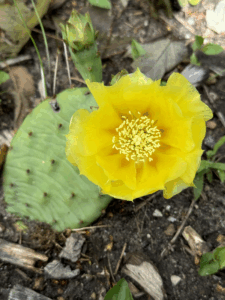
Eastern prickly pear never fails to surprise, with luminous yellow blooms rising from a Midwestern native cactus—an unexpected burst of beauty in an Illinois garden.
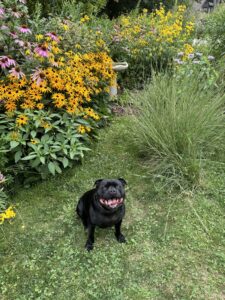
Pig, our pup, smiling in the garden.
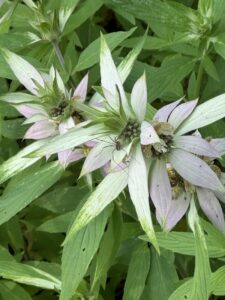
A daddy long legs on spotted horsemint

Pig’s Prairie

Distinguishing feature of our garden

We partnered with the City of Highland Park to secure approval for transforming the wide parkway in front of our property—effectively doubling the size of our native garden. Using an eco-friendly sheet mulching technique, we smothered the existing turf grass to prepare the soil for new plantings. Today, more than half of the space is flourishing with native species, each one now well established and contributing to a vibrant, biodiverse landscape.

How did we become involved in native plant gardening?

We moved to Highland Park in 2020 and knew from the start we wanted to be part of the growing movement to replace traditional lawns with landscapes that are more vibrant, diverse, and environmentally sustainable. As an avid birder since my college days, I saw our new parcel of green as a unique opportunity to create a native garden that would be as beautiful as it was beneficial—drawing in not only birds, but also a wide array of pollinators and other wildlife. 

What motivated us to use native plants?

We believe our yards can—and should—do more than simply look neat and green. Native plants provide essential habitat for birds, pollinators, and other wildlife increasingly displaced
by development. At the same time, we hope to help reimagine and redefine what residential landscapes can be: beautiful, dynamic, and ecologically rich. It’s entirely possible to move beyond the conventional lawn and establish a new aesthetic where every yard helps support biodiversity. 

Have you encountered any unexpected challenges or surprises?

Absolutely. One of the great joys of native gardening is that it’s an ongoing learning experience. Each year brings new insights—about which plants thrive in our specific conditions, which combinations create the most appealing look, and which species turn out to be more aggressive than expected. We’ve come to see our garden as a living laboratory, where we continually refine and adapt. That process of discovery makes the work deeply rewarding and keeps us engaged season after season.

Have you grown especially attached to specific plants? (Why?)

Eastern prickly pear never fails to surprise, with luminous yellow blooms rising from a Midwestern native cactus—an unexpected burst of beauty in an Illinois garden. Prairie smoke charms us with its delicate, wispy seed heads that drift like pink clouds above the soil. And spotted bee balm brings so much intrigue to the garden—its sculptural flowers draw a constant hum of pollinators. These plants bring both visual interest and vital energy to our garden, reminding us why we chose to go native.

Name of our garden

“Pigs Prairie”—named after our beloved Staffordshire bull terrier Pig.

Tips for getting started with native plant gardening
Experiment! Play! Start small with a pocket garden of 5–10 native plants. You’ll be amazed at how much you learn—and how quickly. As your confidence grows, you may find yourself inspired to expand that initial planting and gradually transform your lawn into a vibrant, beautiful, and ecologically rich landscape that supports pollinators and other wildlife. 

Barb’s Garden

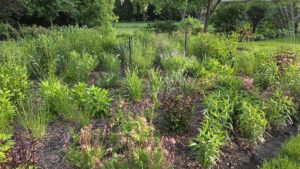
Our backyard meadow
Prairie Smoke, an early blooming native flower

Barbara’s Garden

Distinguishing feature of our garden

We have 2 meadows that require different plants…. In the backyard we planted a meadow in full sun last year. In the front yard we have a new meadow, planted just this spring, which is in shade or partial sun.

We wanted meadows that would attract more bees and butterflies and complement the more formal gardens that border the property. These meadows significantly reduce the amount of lawn to be mowed and weeded; as the plants establish their root systems, the amount of watering required will be minimized.

How did we become involved in native plant gardening?

We have are new to native plant gardening, having cared for extensive cultivars over the years. We have worked closely with Betsy Seff of Red Stem Native Landscapes to plan and install the meadows.


What motivated us to use native plants?

We wanted to increase habitat resources for bees and butterflies. We were quite surprised by how quickly the meadows have grown. Matching plant choices to natural conditions in their proposed locations really pays off!